AET Group rises to the new challenges of European industrial sovereignty
27 July 2026

27 July 2026
Nuclear, defence, decarbonisation, strategic industries: our expertise at the service of tomorrow’s Europe
The issues surrounding industrial sovereignty are currently taking on a new dynamic in Europe. The revival of nuclear power, investment in energy infrastructure, the development of defence capabilities and the acceleration of the decarbonisation of industrial processes are generating new needs in strategic sectors where technical requirements are particularly high.
For over fifty years, AET Group has been supporting major players in the civil and military nuclear sectors, national defence programmes, research laboratories and manufacturers committed to decarbonising their processes.

To meet the increasing workload of French and European nuclear programmes, AET Group is strengthening its nuclear division by recruiting new experts and bringing on board specialist project managers.
As Xavier Brun, Chairman of AET Group, emphasises:

|
“Today, we are taking a new step forward. We are strengthening our nuclear division by recruiting new experts and bringing on board specialist project managers. Our ambition is clear: to increase our operational capacity, strengthen our expertise and respond ever more effectively to our clients’ challenges. We are equipping ourselves with the human resources needed to support the projects of today and tomorrow.”
— Xavier Brun, Chairman of AET Group |
For over fifty years, AET Group has been involved in research, testing and technological development projects for major players in the civil and military nuclear sectors.
This longevity is underpinned by a safety culture deeply ingrained in the teams’ DNA, CEFRI certifications, internal processes tailored to the sector’s requirements, a commitment to compliance with the ISO 27001 standard, and expertise in handling Classified Information and Media. These prerequisites enable the group to work on restricted-access projects whilst meeting the levels of confidentiality and traceability expected by the most demanding clients.

The teams also operate internationally, notably in the United Kingdom, Germany, Italy and the United States, on strategic nuclear projects or those relating to new-generation reactors, adapting their practices to local regulatory environments without compromising on French technical standards
Testing, qualification and analysis of irradiated and non-irradiated materials to extend the service life of the existing fleet
The French nuclear fleet comprises 56 reactors, the average age of which exceeds 35 years. EDF’s Grand Carénage programme requires major maintenance, the retrofitting of numerous pieces of equipment and the requalification of critical components across all sites. In this context, the ASN’s requirements have been significantly tightened, and the need for materials qualification and fuel expertise has never been more critical.
AET Group is involved in the qualification of MOX fuels (a mixture of UO₂ and PuO₂), mechanical and thermal testing of cladding, the characterisation of irradiated and nonirradiated materials, as well as the design of bespoke handling and characterisation equipment suited to highly demanding radioactive environments.
REP, EPR, EPR2, SMR…
The construction of six new EPR2 reactors, with an option for a further eight units, and the development of SMRs are creating significant demand for the development, processing and characterisation of materials. France is thus reaffirming its commitment to a decarbonised and sovereign electricity mix.
AET Group is supporting these programmes through R&D into fuels, cladding and structural materials – particularly in relation to molten salts, lead and sodium – as well as through the qualification of components and the design of equipment suited to the thermal and mechanical stresses of compact SMR reactors.
Remediation, waste management and decommissioning in challenging environments
The decommissioning of nuclear facilities represents a major industrial challenge for the coming decades. In France, several dozen reactors and fuel cycle facilities will reach the end of their operational life in the coming years, requiring a very high level of technical and regulatory expertise in constantly evolving environments.
AET Group is involved in the remediation and decontamination of equipment and structures in highly radioactive environments, the management and conditioning of radioactive waste, the design of suitable handling systems, as well as waste volume reduction, recycling and the recovery of materials.

AET Group is one of a select group of French manufacturers involved in sensitive military nuclear programmes. France’s nuclear deterrent relies on a sovereign industrial chain in which reliability, confidentiality and discretion are non-negotiable.
The Group supports strategic industrial programmes with restricted access, utilising internal processes that guarantee confidentiality and traceability across long-term projects.

Designer and manufacturer of compact induction systems with low environmental impact
Beyond the nuclear sector, ID Partner, an AET Group company specialising in induction technologies, designs and manufactures compact systems for industrial maintenance and the decarbonisation of thermal processes.
These solutions are aimed at demanding sectors such as aerospace, rail, nuclear, plastics, paper manufacturing and rolling. In particular, they enable the heating of strips, rollers, bores, rivets and cylindrical surfaces with improved thermal control and a significant reduction in energy losses compared with conventional fossil-fuel-based processes.
As part of a project carried out with Artelia on a Rafale assembly line, ID Partner was commissioned to modernise a bore-heating process that was facing issues with heating times, thermal repeatability and uniformity, which were directly affecting production rates and process quality.
The solution developed is based on a compact induction system, requiring no water cooling,incorporating intelligent heating cycles and an inductor auto-recognition function. Deployed within four months, it has reduced energy consumption by around 90 per cent compared with the technology previously used, whilst improving process control and repeatability.
As part of a project carried out with the SNCF, ID Partner has developed a portable induction solution for heating rivets used in the repair of railway engineering structures. Traditional methods using coal, gas or petrol resulted in significant energy losses and were physically demanding for operators.
This fully electric solution is compact and portable. It enables repeatable heating up to 1,000°C whilst eliminating the need for fossil fuels on site and significantly reducing operational constraints for maintenance teams.
Beyond its expertise in the nuclear and energy sectors, AET Group is also committed to addressing a major industrial challenge for Europe: securing access to critical and noncritical materials. Within AET Group, AET Technologies and its subsidiary ID Partner are
involved in developing technological solutions dedicated to the recycling and recovery of these strategic resources, which are essential to the energy transition and European industrial sovereignty.

The European Green Deal aims to make the European Union the first climate-neutral continent by 2050. This large-scale transition objective poses significant challenges, particularly regarding the availability of critical materials. Supply chains today remain heavily dependent on a limited number of international players: China alone accounts for 70 per cent of global rare-earth extraction and 90 per cent of rare-earth refining, whilst less than 1 per cent of these materials are currently recycled. This concentration exposes European industry to the risk of supply disruptions for resources that are nevertheless essential to its strategic sectors.
In response to this dependence, Europe is shaping its response through dedicated regulations and initiatives. The ERMA (European Raw Materials Alliance) is coordinating a to support European industry, whilst the Critical Raw Materials Act (CRMA) makes critical raw materials a strategic priority, with a target of 25 per cent of raw materials to come from recycling by 2030. This framework is reflected in stricter requirements for eco-design and metal recycling: R&D and recycling are thus emerging as key drivers of competitiveness, growth and industrial sovereignty in Europe, driven in particular by four key sectors set to shape future European supply chains —lithium-ion batteries, permanent magnets, electronic waste and photovoltaic panels.
Processes for recycling critical and non-critical materials involve numerous thermal operations, including several high-temperature thermal processes: pre-treatment, separation, demagnetisation, pyrolysis, combustion, post-combustion, calcination, melting, purification, etc.
With several decades of expertise in the design of bespoke thermal equipment and in process engineering, we support research centres and industrial clients in the development of their processes, from the initial R&D phases right through to industrialisation.
Our added value encompasses both the integration of technological modules into existing facilities and the design and manufacture of bespoke thermal equipment. From R&D to the industrialisation of processes, we put our expertise in thermal equipment at the service of
both major players in the recycling sector and innovative SMEs. Whether it involves waste sorting systems or the development of innovative recycling processes, we are helping to build a more self-sufficient and sustainable European industry.
A leading manufacturer specialising in metal recycling and sorting approached ID Partner to address a major technical and safety issue.
Traditional metal sorting solutions rely on magnetic wheels rotating at very high speeds to generate the fields required for separation. However, this technology has significant limitations: the frequencies achieved are insufficient to ensure optimal sorting of all metals, particularly those that are most difficult to separate.
Beyond this technical limitation, this equipment poses significant industrial risks. Some wheels, which can weigh up to a tonne and rotate at nearly 50 revolutions per second, present critical issues relating to emergency shutdowns, fire risks, mechanical hazards and operator safety.
To address these challenges, ID Partner has developed a solution capable of generating powerful high-frequency electromagnetic fields using Litz wire technology. The technological challenge lay in managing extremely high power levels, reaching up to 1 megavolt-ampere
with this type of winding — a feat that illustrates ID Partner’s level of expertise in the field of Litz wire and high-frequency electromagnetic applications.
This achievement forms part of a broader strategy: having historically worked closely with players in the electric motor recycling sector and on metal separation issues, ID Partner is now leveraging its pilot system, its in-house induction design office and its range of R&D services to expand its position in advanced sorting technologies as well as the broader challenges of the circular economy.

With over 20 years’ expertise in process engineering, ID Partner provides manufacturers, laboratories and deep-tech start-ups with a design office specialising in induction, power electronics and electromagnetism. The teams are involved from the applied research stages right through to the development of demonstrators and pre-industrial solutions, with the aim of transforming research-driven innovations into industrialisable solutions with high potential.
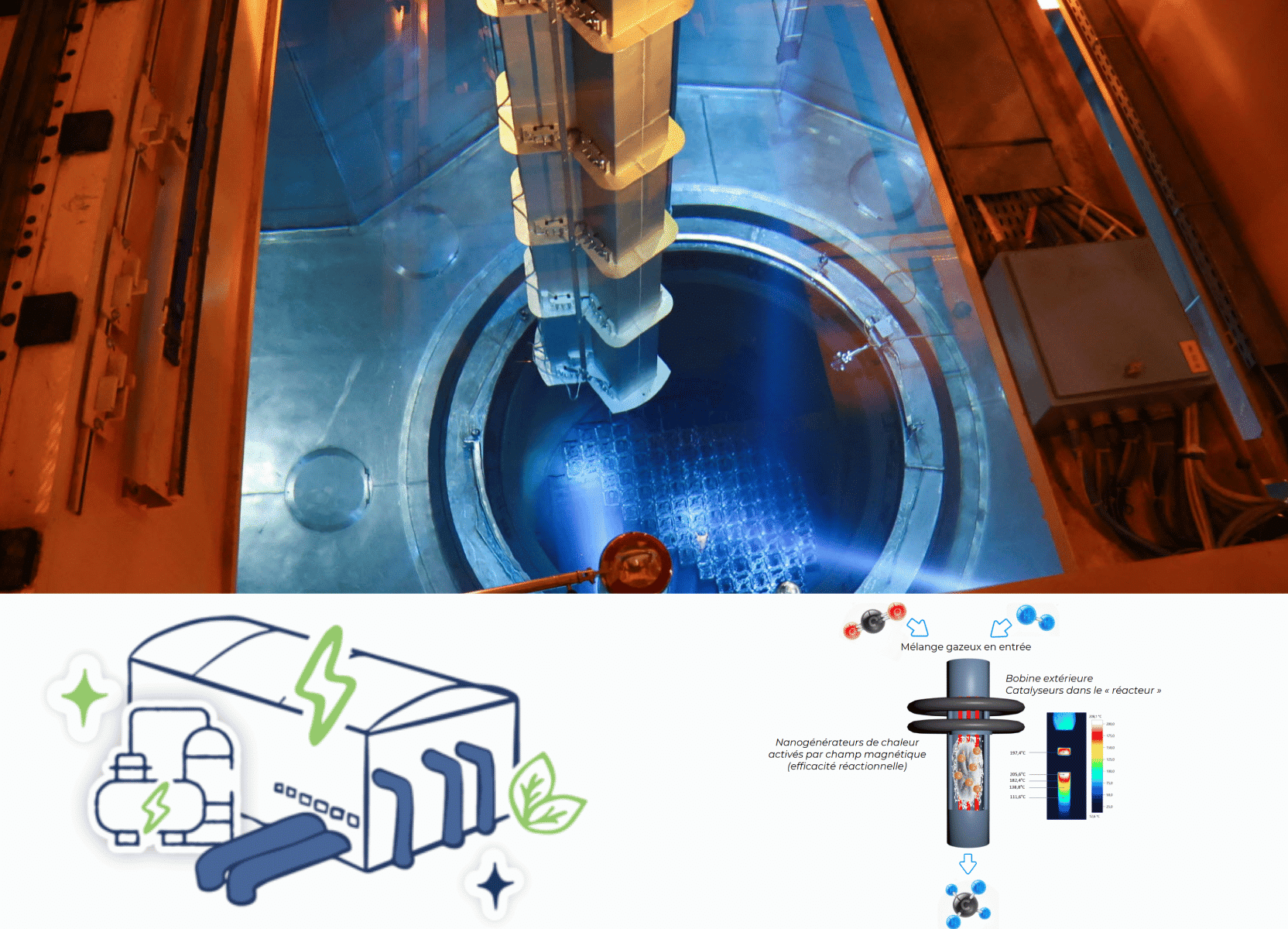
As part of work carried out with the CNRS in Toulouse, the start-up CATMAG is developing a patented technology for heterogeneous catalysis activated by magnetic induction. The aim is to convert CO₂ and hydrogen into biomethane, green methanol and synthetic fuels.
ID Partner is contributing its expertise to develop solutions that deliver energy directly to the catalysts via magnetic-field-activated nano-heat generators, with a view to improving reaction yields, reducing energy requirements and significantly lowering investment costs compared with conventional thermal technologies.
Faced with strategic challenges that have never been more critical for Europe, AET Group has established itself as a trusted partner at the heart of the major industrial transitions of our time. Civil and military nuclear power, national defence programmes, the decarbonisation of industrial processes, and the recycling of critical materials: the Group and its subsidiary ID Partner are active across all the pillars underpinning European industrial sovereignty, from the earliest stages of R&D through to the industrialisation of processes.
Having worked for over fifty years alongside the most demanding clients such as EDF, the Ministry of Defence, the CNRS, Dassault Aviation, Artelia and the SNCF, AET Group has developed a rare level of technical and regulatory expertise, both in the most sensitive
nuclear environments and in induction technologies used for decarbonisation and recycling. These strengths make it one of the few industrial partners capable of working on projects that are as complex as they are sensitive, and of driving disruptive innovations — from securing metal sorting processes to converting CO₂ into sustainable fuels.
At a time when France and Europe are reaffirming their commitment to regaining their industrial and energy autonomy, AET Group is, more than ever, a key player: one which, working behind the scenes of major programmes, is helping to build this sovereignty.